Now appearing on Facebook…a fan club for the random generators.
Author: Leon
Categories
Fake personal is worse than impersonal
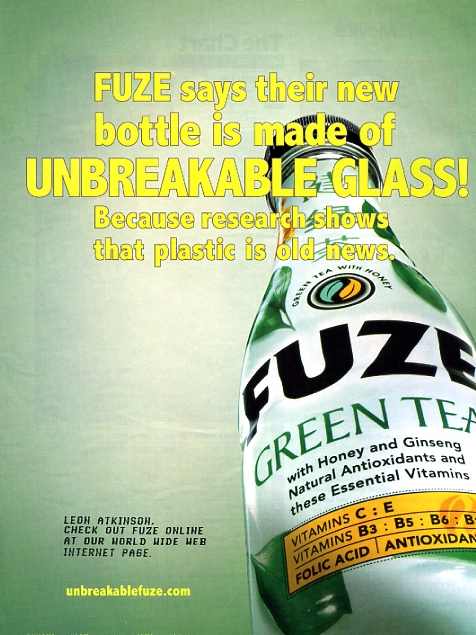
This ad appears in Entertainment Weekly. Actually, this exact ad only appears in my copy, I’m assuming. You might not be able to see it from the thumbnail, but in the lower left there’s some text that looks like it came out of a dot matrix printer from 1984 that reads, “LEON ATKINSON, CHECK OUT FUZE ONLINE AT OUR WORLD WIDE WEB INTERNET PAGE.” Nice.
Your Internet page is on the world wide web? Online? Really? How do I dial it in? Out of all the people who subscribe to Entertainment Weekly, why did you choose me? And if you know anything about me, you know that I’ve been doing a low carb diet since January–so I really wouldn’t be interested in your junk food drink no matter how many vitamins you put in it. Actually, I’m pretty happy drinking plain green tea, and it’s really, really cheap.
This is the yuckiness of direct marketing when it comes to hang out on the Web. The “personalization” that’s being attempted is obviously not genuine. It’s worse than an impersonal broadcast-style ad, which are annoying enough. This ad takes it a step further to purposely insult my intelligence.
What’s the psychographic that follows the call-to-action of this ad? Notice the CTA is to go visit the Web site (I didn’t) not to buy the drink. From the very beginning, they are say, “we know we can’t convince you to drink this with a full-page ad in a magazine. Please come to our Web site and subject yourself to more persuation.” Really? I need to go read about a soft drink on a Web site to decide if I want to drink it? Even if I drank sugar water, I wouldn’t want to spend more than about 5 seconds deciding to drink it or not.
Categories
Core PHP Programming in Google Books
Google Alert just informed me that Core PHP is available for preview in Google Books. It’s an interesting dynamic. It hints that it’s just a preview. I can’t tell if not every page is available or what. But from a practical sense, electronic versions of the book are widespread. I regularly get alerts for links to the book from book blogs. And you’ll find it on the pirate bay separately as well as in gigantic collections of the best technical books. Google makes it easy for people to click to buy the book, but I get a little extra money if people buy through my Amazon affiliate link here on my site.
Late last year, I knocked out a little facebook app that pushed a random status message into your facebook account. I used it as an excuse to learn about the API. It was particularly good because it’s one thing to simply put content up into facebook. It’s another thing to update a user’s status. I got to the idea by way of suggestinon from my buddy, John Szeder. He wanted his status to update without having to log in.
For many months, my little app didn’t do that, exactly. You still had to log in, click into the app and then click a submit button. I knew exactly how to make it automatic, but I let myself be lazy. I thought that if a user never came to use my app, he would never think about my app or see a bit of advertisement. Although I have no expectations that this app will generate real revenue, it’s fun to pretend it might. It’s good practice.
I should take a second here to reveal a “secret”. It’s not really a secret, because it’s easy to find if you want. I’ll tell you now. You can learn a lot of good ideas if you pay attention to Steve Gillmor and his Gillmor Gang. I have had the fortune of having discovered him about three years ago, plus I have a 35-minute commute that gives me a ample time to listen to the podcasts. Sometimes the ideas shared on the show simply spark my imagination. This time they gave me an idea I could use.
The particular idea was that every message on Twitter is an advertisement. As is typical with a Gillmorism, the metaphorical nature of this idea encourages you to leave your dictionary on your desk. Steve went for at least a year straight saying that MS Office was dead. It’s not that it makes no money. It’s not that no one uses it. It’s just that it’s headed for anilation, but hardly anyone has noticed yet.
So, don’t try to take this too literally. A tweet is not a billboard shouting at you about cigarettes that you don’t care to smell, much less smoke. Twitter is a medium for transmitting ideas that you might be interested. It’s smart because it allows you to opt in for those ideas. You’re smart because you chose emitters that you hope will send the type of ideas you’re interested in.
If a tweet is an adverstisement, then so is a facebook status. I’m already funneling all of my tweets into my facebook status. Therefore, they are the same thing. Most people are using the status messages to advertise to their friends the trivia of what they are doing. Some people use them to share links. I’m using them to send people to a random Amazon search on the off chance it will be amusing and they will buy something.
Granted, it’s a fine line. I think my weird, random status messages are interesting. So do about 15 other people (right now). Maybe their friends like it. Maybe their friends find it annoying. Maybe those people like that their friends find it annoying. If I were pushing 20th century shout-style ads, I bet people would be angry.
A little over two years ago, I wrote a post called It’s Time to Destroy Iran. At that time, UN representative Mohamed ElBaradei claimed that Iran was 5 to 10 years away from having nuclear weapons. The tone of the NY Times article was one of relief that we had so long to work on the problem. Of course, 5 years is brief moment in time in the realm of government action. Unfortunately, this week we are learning from the UN that the clock is down to 6 to 12 months.
Given that his estimate of two years ago was 5 to 10 years, and the new estimate is 6 to 12 months, does this almost suggest that Iran virtually has nuclear weapons already? Does 12 months seem like enough time to prepare for an attack on Iran? There have been hints that our government has made some preparations, but it’s also clear that the Bush administration makes no plan to take action before its term is through. We can only hope that Israel will defend itself when there appears to be no alternative.
As with four years ago, the threat of totalitarian governments is the one greatest issue of the presidential campaign. We needed Bush, not Kerry, to execute the Iraq war. He’s fought it with one hand tied behind his back, but our military has made slow progress. I don’t feel any better about McCain than I did about Bush, but it’s very clear to me that Obama would be incapable of handling the crisis we’re headed for.
Last year, McCain joked about bombing Iran to the tune of the Beach Boys song, “Barbara Ann”. Our best hope is that this represents McCain’s true resolve, that he won’t paralize us with endless negotiation. The overwhelmingly important task of the next president will be helping the people of Iran to shed the chains of their totalitarian government, and therefore restoring security to the rest of the world.