I just figured out that after I updated WordPress a couple of weeks ago, it broke permalinks for pages. Ugh. The fix was to go into Settings, switch to another format for permalinks and then switch it back. 😐
Categories
I just figured out that after I updated WordPress a couple of weeks ago, it broke permalinks for pages. Ugh. The fix was to go into Settings, switch to another format for permalinks and then switch it back. 😐
I’ll be heading over the the City to check out the SF New Tech Belly Up tomorrow night, and hanging out with my buddy JJ Behrens.
It’s April Fool’s Day, and out come jokes from popular Web sites. Google usually does a few things. This year they have something called Custom Time, a feature for Gmail that allows you to send the email with a date in the past. It’s mildly amusing, and probably feasible to implement, actually. But one thing stuck out to me: the fake testimonials feature an honest philosopher and a dishonest investment banker.
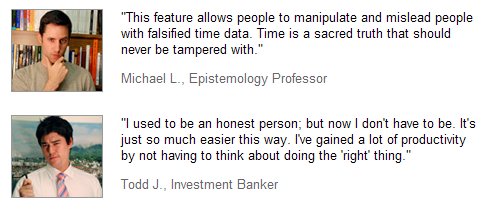
What’s up with that? Isn’t it more likely that the philosophy professor would say something condescending and illogical, such as “Despite what your feeble mind might tell you, time travel must be real because we can imagine it.” The Investment banker should be saying, “In recognizing investments, timing is everything. With Custom Time, I can send that email to that Zuckerberg kid and tell him I will be helping him fund his silly dating site for college kids.”
All I’m saying is, it isn’t nice of Google to add yet another smear on businesspeople, perpetuating a false stereotype. It’s especially true since Google would not have been successful at all without the help of investment bankers. Epistemology Professors likely have had little or no impact on Google.
There’s a general principle to optimization that many people miss, but seems so simple once you know it. I’m sure I first read about it in The Practice of Programming
I’ve found that this approach applies equally well to optimizing money. For example, when you’re running a business, you have a range of expenses. Some of them are for tangible goods, some of them are for outside services and some of them are for salaries. Imagine an office with a fancy coffee maker. Everyone might think it’s a waste of money and a luxury, but the cost of that expense is likely minuscule compared to salaries. You’re usually better off figuring out how to improve efficiencies in your work process than going with cheapo amenities.
Of course, once you know how this work, you can use it deceptively. Politicians do it all the time. Watch how they talk about earmarks, or the apocryphal $100 hammer. You might agree that it’s not a good idea for a congressman to request a $1mil earmark for his wife’s employer, but even $1mil is nothing compared to the most significant costs to the U.S. budget: Social Security and Medicare. If you check the measurements, you’ll find that all the earmarks together total about 1% of the budget, which Social Security and Medicare are about a third. (Total federal spending is about $2.9tril, and Social Security plus Medicare is about $900mil).
I’m a relatively young person in my late 30s. I wonder if I’m not alone in counting on getting absolutely nothing from Social Security by the time I might need it. I’m not taking that chance. I’m saving money in a 401K plus whatever else I can beyond the annual limit of a 401K. I really wouldn’t mind if my taxes were 30% lower and I had to take responsibility for my own retirement.
Last week, the New York Times ran a story on Iraq with the premise that the religious ideas of Islam are being tested and rejected. The author, Sabrina Tavernese, used the phrase, “the American liberation”, which is only remarkable because the reputation of the NYT is that of promoting the idea of the war as a failure. While the war has a definite strategic purpose for the USA, I cannot think of a better achievement of the Iraqi people than for them to move past the outdated ideas of religion.
Here are a people who truly are liberated from a religious or military dictator, finally able to decide for themselves what to think. The laws of Islam have been dramatically exercised in Iraq. To a free man, the idea of screaming “God is great” as you chop off someone’s head is not appealing. In fact, the ideas of the clerics lead only to your own destruction.
When Bush talks about a forward strategy of freedom, I’m not sure he totally understands it. But a disillusionment of religion is exactly the kind of freedom I was hoping for.